
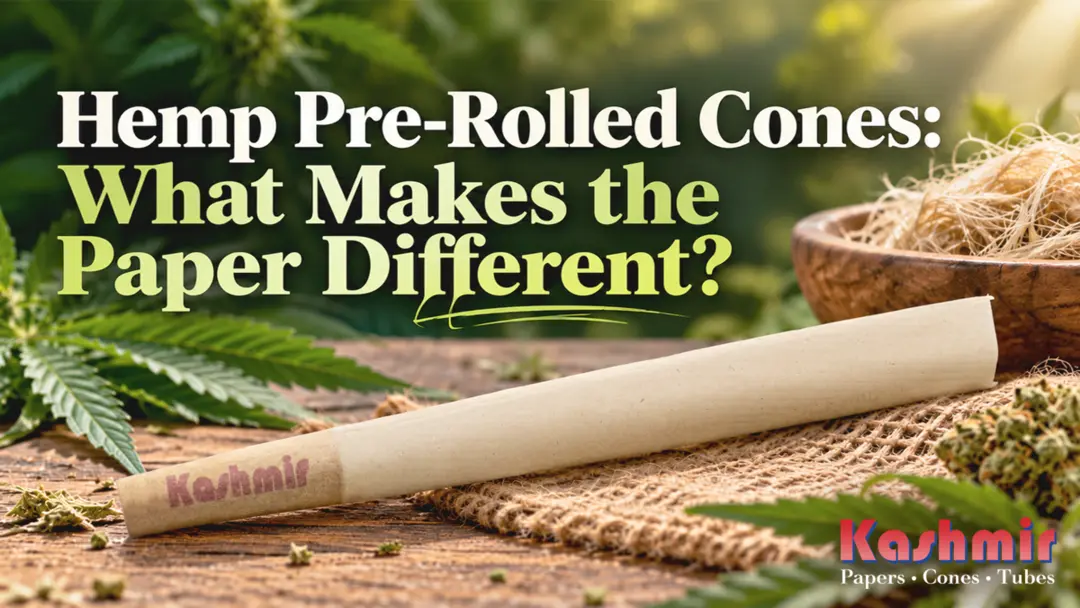
Organic Hemp Pre-Rolled Cones: What Makes the Paper Different?
When a cone is labeled “organic hemp,” the important part is not the cone shape.
It is the paper.
Organic hemp pre-rolled cones use hemp fiber as the base material, and the quality of that paper affects how the cone feels, how strong the sheet is, how noticeable the paper tastes, and how it behaves once lit.
That is what makes this category worth understanding.
The words organic hemp cones can sound like a simple marketing label, but there are actually several separate ideas packed into it: the crop itself, the way the fiber is processed, whether the paper is bleached, how thin the finished sheet is, and how the paper is engineered to burn.
Those are the things worth looking at before choosing one.
What Is Organic Hemp Paper?
Hemp paper is made from fibers taken from the hemp plant rather than conventional wood pulp.
Hemp is particularly useful in papermaking because its bast fibers are relatively long. Longer fibers can form strong bonds in a sheet, which is one reason hemp paper is known for useful tear resistance and durability. Academic reviews of hemp fiber also point to its tensile strength and suitability for specialty paper applications.
That does not mean every hemp paper feels the same.
The finished sheet still depends on how the fibers are pulped, refined, pressed and finished. A manufacturer can make a hemp paper thin, textured, smooth, dense or lightweight depending on how the sheet is engineered.
So the word “hemp” tells you what the paper is based on.
It does not tell you everything about the finished paper.
What Does “Organic” Actually Mean?
This is where the terminology matters.
“Organic” is not just another word for natural.
For a product to be represented as certified organic in the United States, the farm or handling operation has to meet USDA organic requirements. Those standards apply to crops grown for food, feed, and fiber, and certification verifies that the operation complies with the applicable organic regulations.
That is different from simply saying a paper is made from hemp.
A hemp paper can be hemp-based without being certified organic.
Likewise, “organic” does not automatically mean “unbleached,” “chlorine-free,” “ultra-thin,” or “additive-free.” Those are separate product claims that should be checked individually.
That distinction is important because these terms are often grouped together on packaging as though they all mean the same thing.
They do not.
Why Hemp Fiber Works Well for Thin Paper
One of hemp’s useful characteristics is fiber length.
Longer plant fibers tend to bond together well, which can help a thin sheet retain strength even when there is not much paper mass in it. Research on hemp paper has found high tensile strength, while paper-industry sources note that hemp can be made relatively thin while still remaining durable.
That is relevant for rolling paper because thinness and strength have to coexist.
A paper can be thin, but it still needs enough integrity to survive normal handling, folding, filling and packing without tearing immediately.
This is where hemp has a natural advantage as a papermaking fiber.
It can provide a light sheet without relying on thickness alone for strength.
How Organic Hemp Paper Feels
Hemp paper usually has more texture than very smooth, ultra-thin paper styles.
That texture comes from the fiber and the way the paper is finished.
In practice, it can make hemp feel a little more tactile in the fingers. Some people like that because the paper feels easier to grip and less slippery while filling or handling.
It is important not to overstate this, though.
A heavily calendered or very thin hemp paper may feel much smoother than a rougher one. Two papers can both be made from hemp and still have noticeably different surface textures because of how they were processed.
So hemp tends to have a distinct paper feel, but the manufacturer still determines how pronounced that feel is.
Does Hemp Paper Affect Taste?
This is one of the more practical reasons people compare paper materials.
A rolling paper can contribute some flavor of its own, especially if the sheet is heavier or more noticeable.
Hemp paper is often described as relatively neutral, but it may carry a mild earthy character. Kashmir’s own organic hemp rolling-paper page describes its hemp sheet as having very little paper taste, with a mild earthy note.
That is a useful way to think about it.
Hemp is not usually chosen because it adds a strong flavor.
Instead, people often choose it because the paper can be made thin enough that the sheet stays fairly unobtrusive while still retaining some of hemp’s natural paper character.
Taste remains subjective, so the exact effect will vary from person to person.
But it is fair to say that paper weight and paper composition both influence how noticeable the sheet is during use.
Does Organic Hemp Paper Burn Slower?
This needs a careful answer.
You will often see hemp papers marketed as “slow burning.”
That does not mean hemp fiber automatically burns slower than every other paper material.
Burn behavior depends on the finished sheet: its thickness, density, porosity, additives, watermark or embossing, gum, and how evenly the cone is packed.
A recent technical review of rolling papers makes this point clearly: the fiber name alone does not determine burn behavior; the engineering of the finished paper matters more.
So when a brand describes an organic hemp cone as slow-burning, treat that as a claim about that finished paper, not a universal law about hemp.
As an example, Kashmir describes its organic hemp cones as embossed and designed for a slow, even burn.
That tells us something about Kashmir’s product construction.
It does not mean every organic hemp cone from every manufacturer will burn identically.
Organic Does Not Mean Unbleached
This distinction deserves its own section because it is easy to mix up.
“Organic” describes the way the crop is grown and certified.
“Unbleached” describes how the paper has been processed after the fiber is harvested.
Those are different things.
An organic hemp paper may also be unbleached, but that is an additional characteristic rather than something guaranteed by the word “organic.”
The same applies to chlorine-free processing.
Kashmir’s current organic hemp cone range combines these claims: the company describes its paper as organic, unbleached and chlorine-free.
That combination is useful to know, but each term should still be understood separately.
Organic tells you about the source crop.
Unbleached tells you the paper was not whitened in the conventional way.
Chlorine-free tells you more about the bleaching or processing chemistry.
What About Additives and Gum?
The base paper is the most important part of the cone, but it is not the only paper-related detail worth checking.
The adhesive matters too.
Rolling papers typically use a gum line so the paper stays sealed once formed. The type of gum varies by product and manufacturer.
Some hemp-paper products use plant-based gum such as acacia or other natural adhesives. That is a separate product specification and should not be assumed just because the paper itself is organic.
The same principle applies to dyes, coatings and flavor additives.
If a product is marketed as organic hemp, the buyer should still check whether the finished paper includes any additional treatments or added ingredients.
The more complete the specification, the easier it is to understand what you are actually buying.
Why Unbleached Hemp Paper Looks Brown
Organic hemp papers are often light brown, tan or beige.
That color usually comes from leaving the paper unbleached rather than whitening it to a bright white finish.
The color itself does not make the paper better or worse.
It simply tells you something about the way the sheet has been processed.
This is another reason it is useful to separate paper appearance from paper performance.
A brown hemp cone may still be thick or thin, smooth or textured, slow-burning or faster-burning depending on how it is made.
Color is one clue.
It is not the whole specification.
How to Judge Organic Hemp Paper Quality
If the article is really about organic hemp, this is where the buying advice should stay focused.
The most useful things to check are the paper itself:
Does the manufacturer clearly state that the paper is made from organic hemp fiber?
Is there a certification or defined organic claim?
Is the paper unbleached?
Is it chlorine-free?
Does the manufacturer specify whether it is pure hemp or a blend?
Is the sheet lightweight or ultra-thin?
Does it describe any embossing, watermarking, or other paper treatment?
Does the brand explain the type of adhesive used?
Those questions tell you much more about the paper than the cone length or pack quantity.
That is also where the original version of this blog went off track.
Size, tips and jars are relevant to cones in general, but they are not what makes an organic hemp pre rolled cone different.
The paper is.
Pure Hemp vs Hemp Blends
Another point worth checking is whether “hemp paper” means 100% hemp or a blend.
Commercial hemp papers can be made entirely from hemp fiber, but they can also be blended with wood pulp or other fibers depending on the product. Paper-industry guidance specifically warns that the material name on a product does not necessarily tell you the fiber percentage.
That is why a clear material specification matters.
If a product says “100% hemp,” that is different from a paper that contains some hemp fiber in a blend.
Neither is automatically bad.
But they are not the same product.
For someone specifically searching for organic hemp cones, this is one of the most useful details to verify.
Environmental Claims Need the Same Care
Hemp is often discussed as an environmentally preferable paper fiber, but broad sustainability claims can become exaggerated quickly.
Hemp grows differently from trees, uses bast fiber rather than wood pulp, and has a long history in papermaking. Its fiber strength makes it useful for specialty papers.
But the environmental footprint of a finished rolling paper also depends on farming, pulping, processing, transportation and packaging.
So it is better to avoid saying that hemp paper is automatically “eco-friendly” simply because it comes from hemp.
If a manufacturer makes a specific sustainability or certification claim, that should be evaluated on its own evidence.
That is more useful than turning the fiber into a blanket environmental promise.
Where Kashmir Fits
Kashmir can work as an example here, but it should stay an example rather than drive the whole article.
Kashmir’s current organic hemp cones are described as made from organic hemp fiber and as unbleached and chlorine-free. The company also describes the paper as embossed and engineered for a steady burn.
Those details illustrate the kinds of specifications worth checking in any organic hemp cone:
the fiber source, processing, paper finish and construction.
The size of the cone, tip style and pack count can still matter when someone is actually buying a product, but they are secondary to the subject of this article.
Final Takeaway
Organic hemp pre-rolled cones are primarily different because of the paper, not the cone format.
Hemp fiber can produce a thin, strong sheet because of its relatively long fibers. Organic certification speaks to how the crop is grown and handled. Unbleached and chlorine-free describe additional processing choices. Paper thickness, density, embossing and other manufacturing details influence how the finished sheet feels and burns.
So when choosing organic hemp pre rolled cones, do not start with cone size or pack count.
Start with the paper.
Ask what the hemp content actually is, whether the organic claim is defined, how the paper is processed, whether it is bleached or unbleached, how thin the sheet is, and what the manufacturer says about the finished paper construction.
That is where the real difference is.