
Unbleached Pre-Rolled Cones: What Does Unbleached Really Mean?
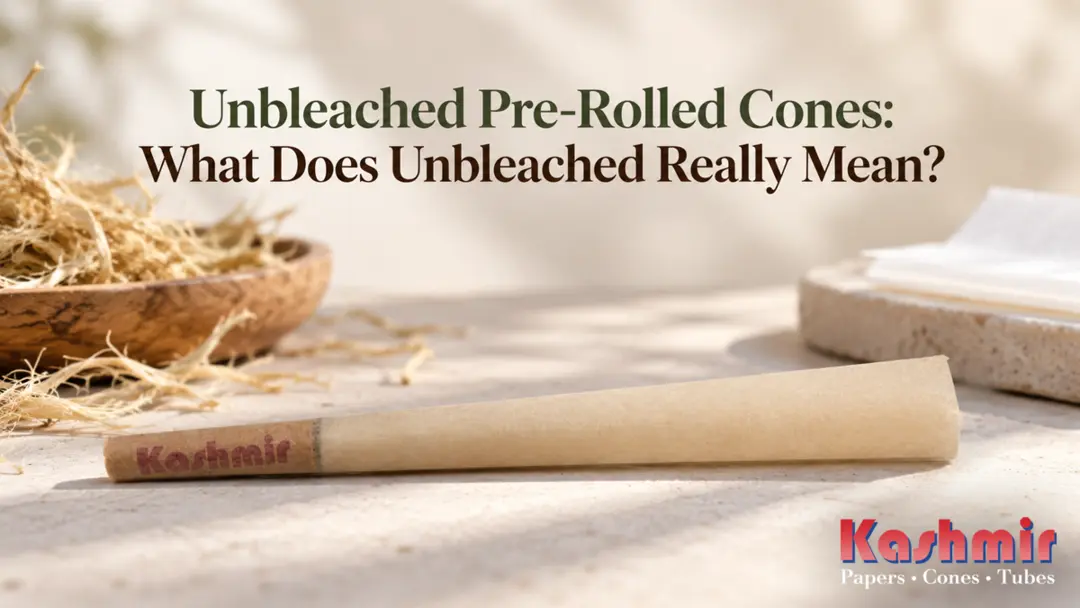
The brown or tan color is usually the first thing people notice about an unbleached cone. It is also where a lot of the confusion starts.
“Unbleached” does not mean the paper is automatically organic, ultra-thin, slower-burning or better quality than white paper. It describes something much more specific: how the pulp was processed before it became paper.
In conventional papermaking, bleaching is used to increase the brightness of pulp and create a lighter finished sheet. The U.S. Forest Service defines bleaching as chemically treating pulp to alter its color and increase brightness, often alongside the partial removal of non-cellulosic material.
Unbleached paper skips that whitening stage, allowing more of the pulp’s original tan or brown color to remain.
For someone choosing unbleached pre rolled cones, understanding that distinction is more useful than simply assuming brown paper must be more “natural” or perform differently.
What Does Unbleached Actually Mean?
Paper begins with plant fibers that are separated, processed into pulp and eventually formed into a sheet. Depending on the paper being produced, that pulp can go through additional treatments before it reaches its final appearance.
Bleaching is one of those treatments.
The purpose is mainly to increase brightness and remove or alter compounds responsible for the darker color of untreated pulp. Modern paper mills can use several bleaching systems. EPA documentation describes both chlorinated chemicals and non-chlorinated options such as oxygen, peroxide and ozone.
That is worth knowing because the word “bleached” is sometimes treated as though it refers to one single process.
It does not.
Some papers may be treated with chlorine-containing compounds, while others can be brightened through totally chlorine-free systems using oxygen, ozone, peroxide or related processes.
An unbleached paper, by contrast, has not undergone that kind of whitening process to create a bright white sheet.
This is the central meaning of the term.
Why Are Unbleached Cones Brown?
That natural-looking brown color comes from the pulp itself.
Plant fibers contain cellulose along with other components that contribute to the color of untreated pulp. Bleaching and brightening processes remove or alter some of those color-forming materials. When that stage is skipped, more of the original tan or brown appearance remains.
That is why unbleached rolling cones commonly have a beige, tan or light-brown sheet instead of a bright white one.
The color should not be confused with added flavor or a decorative dye. It is simply the appearance of paper that has not been brightened in the same way.
But the brown color does not tell you which fiber was used.
An unbleached paper might be produced from hemp, wood-based pulp, bamboo or a blend of fibers. It also does not tell you how thick the paper is.
Two brown cones can therefore look similar while feeling and performing quite differently.
Color gives you one clue about the processing. It does not give you a complete specification.
Unbleached, Organic, Ultra-Thin and Chlorine-Free Are Different Things
This is probably the most important distinction to understand when reading rolling-paper packaging.
Terms such as unbleached, organic, ultra-thin and chlorine-free often appear close together, which can make them sound interchangeable. They describe different properties.
“Unbleached” refers to whitening. The paper has not been brightened in the same way as conventional white paper.
“Organic” refers to the source material and how the crop was grown or certified. An organic hemp paper can also be unbleached, but one claim does not automatically guarantee the other.
“Ultra-thin” refers to the construction or weight of the finished sheet. An unbleached paper can be ultra-thin, but it can also be made with more body.
“Chlorine-free” gives additional information about the processing chemistry. EPA identifies totally chlorine-free bleaching systems that use combinations of oxygen, ozone, enzymes and peroxide instead of chlorine-containing bleaching chemicals.
That means a product can legitimately carry several of these descriptions at once, but each term is telling you something different.
For shoppers, separating those claims makes the label much easier to understand.
Does Unbleached Paper Taste Different?
Paper can contribute some flavor of its own, but bleaching status is only one part of that experience.
Fiber type, paper thickness, gum and overall construction can all affect how noticeable the paper is once it is being used. A thin paper puts less paper material around the fill than a heavier sheet, which can reduce how prominent the paper feels or tastes.
This is why it is too broad to say that every unbleached cone has “no paper taste.”
Some manufacturers position unbleached papers as having a more neutral character, and some people prefer the less-processed paper style for that reason. But taste remains subjective, and the weight and fiber of the sheet matter alongside the bleaching process.
A very thin unbleached paper may feel relatively unobtrusive.
A heavier unbleached paper can be more noticeable even though it has the same brown appearance.
So if paper taste matters to you, look at processing and paper weight together, rather than relying on color alone.
Does Unbleached Paper Burn Slower?
Not simply because it is unbleached.
Burn behavior is influenced by the entire construction of the finished sheet. Thickness and density matter, but so can porosity, embossing, gum and how evenly the cone itself is packed.
That means two unbleached papers can behave differently even if they look almost identical.
One could be ultra-thin and lightweight. Another might have more paper mass. One might use embossed construction while another has a smoother surface.
The same principle applies to white paper.
Bleaching mainly tells us something about pulp brightness and processing; it is not a universal burn-speed specification.
So when a specific paper pre rolled cone is described as slow-burning or even-burning, that claim should be evaluated as a characteristic of that finished paper rather than a property automatically created by its brown color.
This distinction also keeps the article from falling into the common assumption that:
unbleached = slow and bleached = fast.
The real relationship is more complicated than that.
Is Unbleached Paper Better Quality?
Not automatically.
Quality comes from how well the paper has been made.
A good sheet should have reasonably consistent thickness and construction. The paper should be suitable for the job it was designed to do, and any claims about fiber, processing or thickness should be clearly described by the manufacturer.
A poorly made unbleached sheet does not become high quality simply because it is brown.
Likewise, a properly made white sheet should not be treated as poor quality merely because it has been brightened.
That is why unbleached paper is better understood as a preference and processing choice, not a universal quality ranking.
Someone may choose it because they prefer its appearance, want paper that has not undergone whitening, or prefer a particular unbleached product’s construction.
Those are meaningful reasons without needing to claim that one paper color is universally superior.
What Should You Check Before Choosing Unbleached Cones?
Once you understand what “unbleached” means, choosing between products becomes much easier.
Start with the fiber.
Find out whether the paper is made from hemp, bamboo, wood-based pulp or a blend. The raw material can influence texture, strength and how the paper feels in the hand.
Then look at the finished paper construction. If the manufacturer provides information about thickness, paper weight, embossing or another surface treatment, those details give you a better picture of how the cone is likely to feel than the brown color alone.
Processing claims are worth checking carefully too.
If a product is described as chlorine-free, that tells you something additional beyond the fact that it is unbleached. If it is described as organic, that is another separate claim that should be supported by the manufacturer rather than assumed from the paper’s appearance.
The useful question is therefore not simply:
“Is this cone unbleached?”
It is:
“What kind of unbleached paper is this?”
That second question gets you much closer to understanding the product.
Kashmir Unbleached Cones as an Example
Kashmir provides a useful example of how these paper descriptions can overlap without meaning the same thing.
Its current unbleached cone range is described as using light-brown, unbleached and chlorine-free paper. Some products also use embossed paper construction.
Those are three different pieces of information.
The light-brown appearance describes what you see. “Unbleached” describes the lack of a whitening process. “Chlorine-free” provides additional information about processing, while embossing refers to the construction of the finished sheet.
That is the right way to read product specifications.
Instead of treating “unbleached” as a catch-all claim, look at the supporting details around it.
Final Thoughts
The biggest thing to know about unbleached pre rolled cones is surprisingly simple: unbleached describes a paper-processing choice.
The pulp has not been brightened in the same way as conventional white paper, which is why the finished sheet usually keeps more of its natural tan or brown appearance. Bleaching itself can involve several different processes, including chlorine-containing and non-chlorinated methods such as oxygen, peroxide and ozone.
From there, everything else needs to be considered separately.
Unbleached does not automatically mean organic. It does not automatically mean ultra-thin or chlorine-free. And it does not guarantee a specific burn rate, taste or level of quality.
Those qualities depend on the fiber, paper weight, construction and specific processing claims of the finished sheet.
That is a much more useful way to compare unbleached cones than judging them simply by whether the paper is brown or white.