
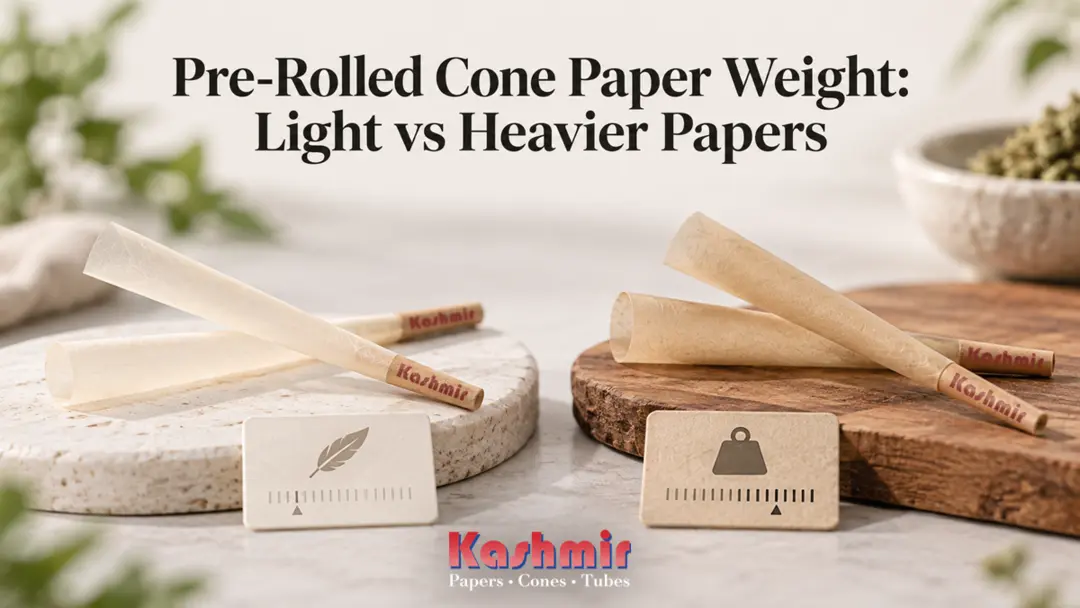
Pre-Rolled Cone Paper Weight: Light vs Heavier Papers
Terms such as thin, ultra-thin and lightweight appear on rolling-paper packaging all the time. The problem is that those words do not have one universal definition.
One manufacturer’s “ultra-thin” paper may not weigh exactly the same as another manufacturer’s. That is why paper weight is a much more useful way to understand what you are actually buying.
Paper makers commonly describe basis weight in grams per square meter, or GSM (g/m²). A paper rated at 14 GSM means that one square meter of that paper would weigh 14 grams. The individual cone obviously weighs only a tiny fraction of that, but GSM creates a consistent reference point for comparing sheets. Basis weight is an established paper-industry measurement rather than a marketing description.
For pre-rolled cones, that number can tell you quite a bit about how much paper is present, how delicate the sheet may feel, and how much structure it provides while being filled.
What Does GSM Mean for Rolling Paper?
GSM measures the mass of the paper per unit area. Lower numbers generally indicate a lighter sheet, while higher numbers indicate more paper mass in the same area.
That is related to thickness, but the two terms are not perfectly interchangeable. Two sheets with the same GSM can differ somewhat in actual caliper because fiber type, density and manufacturing methods also affect the finished paper.
Still, GSM gives shoppers a much better comparison than words such as “thin” or “premium.”
Published rolling-paper references commonly place papers somewhere around 10 to 25 GSM, although exact ranges differ by manufacturer and paper type. One current guide breaks lighter rolling papers into roughly 10–12 GSM, middle weights around 12–14 GSM and somewhat heavier papers around 14–16 GSM, while broader industry references extend into the low-20s for heavier paper constructions.
Those ranges should be treated as useful reference points, not official categories.
There is no universal rule saying that 12 GSM must be called “ultra-thin” while 15 GSM must be called “standard.”
Why Paper Weight Matters
Paper weight changes more than how the sheet feels between your fingers.
A lighter sheet contains less paper material around the fill. It usually feels finer and more flexible, and it can be less visually noticeable because many low-GSM papers are somewhat translucent.
The trade-off is handling.
Very light paper has less physical body, so it can require more care during filling and packing. That is especially noticeable with loose rolling papers, but even a pre-shaped cone benefits from gentler handling when the sheet is very light.
A heavier paper gives your fingers more material to work with. It tends to feel firmer, holds its form more readily and can be more forgiving during normal handling.
That extra structure does not automatically make it higher quality.
It simply creates a different paper experience.
This is why GSM is best viewed as a design choice rather than a quality score. Two well-made papers can have very different weights because they were designed for different preferences.
What Counts as Light or Heavy Rolling Paper?
There is no official industry threshold, but looking at actual paper specifications gives us a useful picture.
Rolling-paper sources commonly show very light papers beginning around 10–12 GSM, with many thin papers falling in the 12–16 GSM area. Heavier rolling papers can extend upward toward roughly 20–25 GSM, particularly with denser pulp-based sheets.
One rolling-paper manufacturer that publishes technical options, for example, lists papers ranging from approximately 12.5 GSM to 24 GSM, including rice, hemp, bamboo and specialty papers.
That gives us a more useful spectrum:
| Approximate Paper Weight | General Character |
| 10–12 GSM | Very light, fine and delicate |
| 12–14 GSM | Light paper with somewhat more handling structure |
| 14–16 GSM | More noticeable body and firmness |
| 16 GSM and above | Progressively heavier, more substantial sheet |
These are broad reference ranges rather than official labels.
A manufacturer may market a 14 GSM paper as “ultra-thin,” while another company may reserve that description for something lighter.
That is exactly why the GSM figure is more useful than the marketing term.
Lighter Paper: What Are the Advantages?
The clearest advantage of lighter paper is simply that there is less paper surrounding the fill.
For someone who prefers the paper itself to stay less noticeable, that can be appealing. Less paper mass can also mean less ash from the paper portion of the cone and a lighter overall paper presence.
Lighter papers can feel more flexible as well. Instead of having a firm, almost rigid surface, the sheet conforms easily to the cone shape.
But that lightness comes with a handling trade-off.
A very low-GSM paper can feel more delicate when the cone is being filled or tamped. It is easier to crease, and rough handling can place more stress on the sheet.
This does not mean light papers are weak by definition. Fiber type matters enormously. Long or strong plant fibers can help manufacturers produce relatively light sheets that still have useful tensile strength.
That is why GSM should never be considered in isolation.
Heavier Paper: What Changes?
Heavier paper feels more substantial immediately.
There is simply more paper mass in the sheet, which usually gives it greater stiffness and body. For some people, that makes the cone easier to handle because there is more structure around the fill.
A heavier paper may also be more forgiving during packing. Small handling mistakes are less noticeable when the sheet has more body.
The trade-off is that the paper itself becomes a more noticeable part of the finished cone.
There is more paper surrounding the contents, more paper material to combust, and potentially more paper character in the overall experience.
This is why neither extreme should automatically be treated as the “better” choice.
A heavier paper prioritizes handling and structure.
A lighter paper prioritizes reduced paper presence.
The useful choice depends on which characteristic matters more to the person using it.
Does Paper Weight Affect Taste?
It can.
When more paper is present around the fill, there is more paper material involved in combustion. That can make the characteristics of the paper somewhat more noticeable.
A lighter sheet reduces the amount of paper present, which is one reason low-GSM papers are often marketed toward people who prefer less paper influence.
But weight is not the only factor affecting taste.
The fiber itself matters. Rice, hemp, bamboo and wood-based papers can have different natural characteristics. Bleaching, additives, gum and other processing choices can influence the finished sheet as well.
So two 13 GSM papers made from different fibers may not taste or feel identical.
The better way to think about it is:
GSM tells you how much paper is there. Fiber and processing tell you more about what that paper is like.
Those two pieces of information work together.
What About Burn Rate?
This is where simple “thin versus thick” rules become unreliable.
Paper weight influences the amount of combustible paper in the cone, so it is clearly relevant. However, actual burn behavior also depends on paper density, porosity, fiber composition, additives, surface treatments, gum, airflow and how evenly the cone is packed.
Rolling-paper technical references specifically separate GSM from properties such as porosity because two papers with the same basis weight can still behave differently once lit.
This is also why you will find conflicting generalizations about whether thinner paper always burns slower or faster.
The most defensible conclusion is not that one GSM automatically produces one burn speed.
It is that paper weight is one factor in burn behavior, but the construction of the entire sheet determines the final result.
If a manufacturer claims a particular cone is designed for a slow, even burn, that claim should therefore be considered alongside the paper weight rather than explained by GSM alone.
Fiber Type and GSM Are Separate Decisions
One of the most useful things to understand about paper weight is that it does not belong to one specific fiber.
Hemp can be made into relatively light paper.
Rice is commonly used for very light sheets.
Bamboo can also be made into lightweight paper while retaining useful strength.
Wood-based papers are often somewhat heavier, although there are exceptions in every category.
Published rolling-paper specifications illustrate the overlap. One source lists rice papers around 10–14 GSM, hemp around 14–18 GSM and wood-pulp papers around 18–25 GSM, but individual products can fall outside those ranges.
So someone should not assume that “hemp” automatically means heavy or that “rice” automatically means one exact GSM.
The fiber affects texture, strength and flexibility.
The GSM tells you how much of that paper material exists per square meter.
Why “Ultra-Thin” Is Still Useful — With a Limitation
The phrase ultra thin pre rolled cones is not meaningless.
It gives shoppers a quick signal that the manufacturer intends the paper to feel especially light.
The limitation is that the phrase does not tell you how light.
Without a GSM specification, two products marketed as ultra-thin cannot necessarily be compared objectively.
That makes “ultra-thin” useful as a description, but not as a standardized technical category.
If a manufacturer publishes the basis weight, the GSM number gives you the clearer reference.
If it does not, then “ultra-thin” should be understood as a relative marketing description within that particular product range.
How to Compare Paper Weight When Choosing Cones
If paper weight matters to you, start by checking whether the manufacturer publishes a GSM figure.
When it does, compare that number with the material.
A 12 GSM rice paper and a 12 GSM hemp paper have the same basis weight, but they can still differ in surface texture, flexibility and strength because the fibers are different.
Then consider what you want from the paper.
Someone who wants less paper presence may prefer a lighter basis weight.
Someone who prioritizes a little more firmness during filling may prefer a heavier sheet.
And if the product is simply described as “ultra-thin” without a number, treat that as the manufacturer’s description rather than an industry-standard measurement.
Kashmir as an Example
Kashmir currently uses terms such as ultra-thin across parts of its cone range.
That is useful for identifying the lighter-paper option within the Kashmir lineup, but it should not be interpreted as a universal GSM category unless an exact paper weight is provided for that product.
This is a good example of the distinction between marketing terminology and technical specifications.
“Ultra-thin” tells you the intended paper style.
A GSM value, when available, tells you how the paper weight is actually measured.
For an educational article, that distinction is far more useful than simply comparing an “ultra-thin” cone against a supposed “standard” cone.
Final Thoughts
Paper weight is one of the most useful specifications for understanding how a rolling paper or pre-rolled cone is likely to feel.
Lower-GSM papers contain less paper mass and tend to feel lighter and more delicate. Higher-GSM papers have more body and can feel firmer and easier to handle.
But neither end of the spectrum automatically means better quality.
Fiber strength, density, porosity, processing and paper construction all matter alongside the basis weight. Two papers with identical GSM numbers can still handle and burn differently.
That is why terms such as “thin” and “ultra-thin” are best treated as descriptions rather than precise standards.
If you really want to understand the paper, look for the number behind the description.
GSM tells you how much paper is there. The material and construction tell you what that paper will be like to use.
That is a much more useful way to compare light and heavier pre-rolled cone papers.