
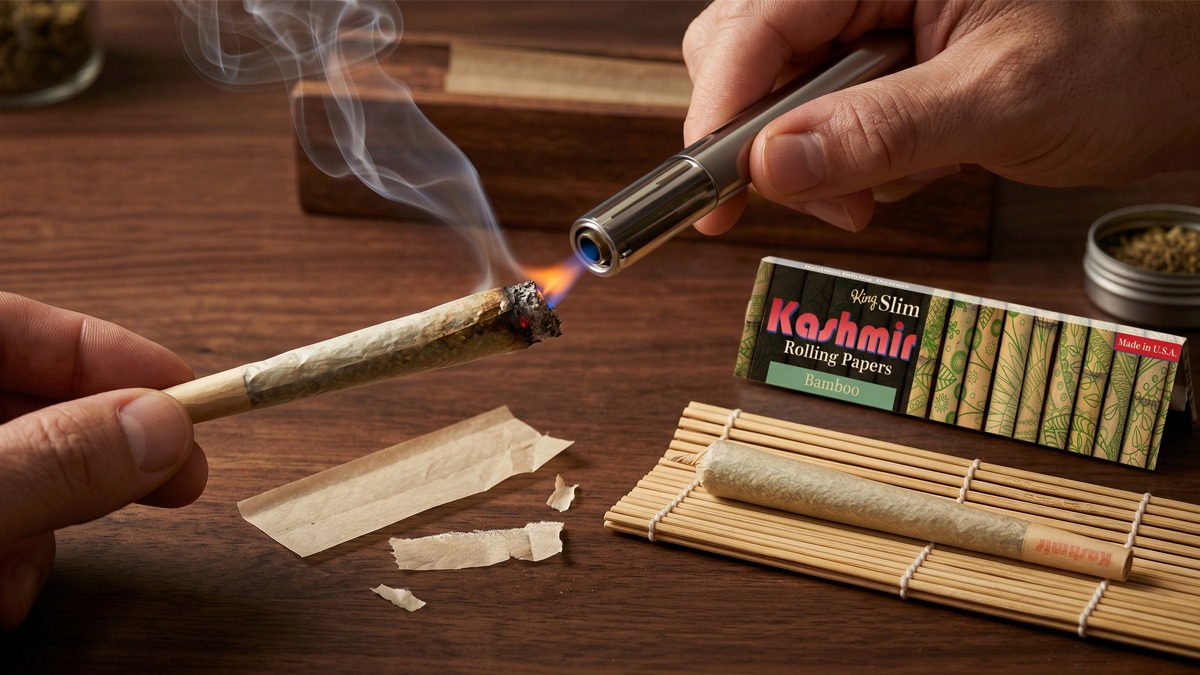
Why Rolling Papers Tear or Burn Unevenly (And How to Fix It Like a Pro)
You did everything right: ground it down, packed it even, licked the seam with just enough moisture, and sparked the tip. Then you watched one side race ahead while the other barely smoldered, or worse, the paper split open mid-roll before you even got it lit. That is rolling paper tearing, and uneven burning in action.
If your rolling papers are tearing in the middle of the roll, or if they burn on one side and barely catch, there are only a few possible causes for both problems, and they’re all fixable.
This guide breaks down every one of them, moisture: grind consistency, paper quality, rolling tension, and lighting technique, and gives you practical fixes you can use right now. By the end, you will know exactly what to change, and if you want a paper that works with good technique, Kashmir420’s rolling paper collection is a solid place to start.
At a Glance: Common Problems and Their Causes
Before we get into the mechanics, here’s a quick reference for the most common rolling problems:
| Problem | Root Cause | Quick Fix |
|---|---|---|
| Paper tears mid-roll | Dryness, over-gripping, or thin rolling paper issues | Adjust humidity, lighten grip, upgrade paper |
| One side burns faster (canoeing) | Uneven grind, loose pack, or off-center lighting | Grind finer and more uniformly; rotate while lighting |
| Paper burns through too fast | Low-quality wood pulp or overlapping gum line | Switch to hemp or bamboo paper |
| Goes out, needs constant relighting | Over-tight roll blocking airflow | Loosen pack, maintain springy density |
| Sticky seam fails to hold | Too much moisture or degraded adhesive | One light pass, let settle before sealing |
| Burn runs along one side | Wind, uneven fill, or poor humidity control | Shield from airflow, pack in even layers |
Why Rolling Papers Keep Tearing (The Real Reasons)
Most of the time, tearing is not due to the paper being too thin. More frequently, it is caused by a combination of environmental factors, handling practices, and paper quality that are at odds with one another.
1. Moisture at the Wrong Level
The thickness of rolling papers varies when they are moistened. They are brittle when too dry, weak and floppy when too humid. Proper paper moisture control is essential for maintaining consistent burn quality and preventing tearing during rolling.
Ideal range: 50–60% humidity. If it doesn’t fall in that range, even high-end rolling papers will behave unpredictably. When not in use, keep papers in a sealed case/tin, especially during the summer or in high-humidity environments.
2. Wet or Oily Hands
Just a bit of moisture or oil on your fingers can cause a paper to weaken before you even begin rolling.
If you begin tearing your papers in the same place, usually just above the area where your thumbs press at the start of the tuck, it’s probably because of moisture in your hands. Before rolling, wash and dry your hands thoroughly, and keep a small cloth on hand to dry them again if needed.
3. Excess Grip Pressure
Most tearing happens when you squeeze too hard while trying to control loose material. Rolling should be gentle shaping, not force.
Tuck from the top with forefingers, and push up with the thumbs in a rolling motion. The paper should curl with you, not resist you. If it’s resisting, the fill is uneven, or the paper is already compromised by moisture.
4. Old or Poorly Stored Paper
Paper and gum strips will deteriorate with time due to exposure, heat, and humidity.
Keep papers flat, sealed, and out of the heat. When the gum strip becomes faded, cracked, or discolored, the paper will no longer be viable.
Why Rolling Papers Burn Unevenly
Uneven burning comes down to airflow imbalance, inconsistent packing, and lighting technique.
1. Inconsistent Grind
Small pieces of fire burn faster than large pieces, causing uneven combustion.
The answer is getting a medium fine grind, without a buildup of dust in the bottom of the grinder. If you are getting powdery bits in your grinder, clean it and grind more slowly.
2. Pack Density Issues
- Too loose → fast airflow → uneven burn
- Too tight → poor airflow → constant relighting
3. Poor Lighting Technique
Lighting one side more than the other creates a permanent burn imbalance. This is especially pronounced outdoors or near vents where environmental airflow pushes the burn along one edge.
Rotate the roll while lighting. Apply the flame in a slow, even sweep across the tip while turning between your fingers. Once the tip is evenly lit, take a single slow draw to establish a level burn front before smoking normally.
4. Paper Quality Problems
Thin or unevenly distributed gums will cause low-quality papers to burn unevenly.
The more even the fiber structure, the more evenly the paper will burn, which is what bamboo and hemp papers do. This is a paper quality comparison in practical terms. Browse Kashmir420’s selection of rolling papers to see how material type affects performance across different paper weights and sizes.
5. Wind and Environment
Airflow from wind or vents can speed up one side of the burn.
Not All Rolling Papers Burn the Same — Here’s Why
Different materials behave very differently:
- Organic Hemp → Slow, even burn, beginner-friendly.
- Bamboo → Very smooth and consistent burn.
- Ultra Thin → Clean flavor but requires skill.
- Unbleached → Natural, steady combustion.
- Rice → Ultra-lightweight paper with a slow, clean burn and minimal paper taste.
- Flavored → Adds enhanced taste and aroma while maintaining a smooth, consistent burn.
- Medical Grade → Premium refined paper designed for purity, smooth airflow, and controlled combustion.
Natural fiber papers like hemp and bamboo tend to burn the most evenly due to their uniform structure.
Step-by-Step: How to Fix Rolling Issues
These rolling tips will show you how to roll properly from now on.
- Grind consistently (medium-fine, no chunks or dust).
- Keep your hands dry and clean.
- Fill evenly in layers.
- Maintain firm but springy packing.
- Use minimal moisture on the gum line.
- Let it settle before lighting.
- Rotate while lighting for an even burn.
Pre-Rolled Cones: Why They Burn More Consistently
Pre-rolled cones remove the two most significant factors in the rolling consistency (shape and tuck pressure). Due to the pre-formed cone structure, there is no need to set the paper in place, which is required with conventional cones.
The pre-formed cone structure eliminates the need to position the paper, which would be necessary with conventional cones. You pack, not roll, which means there is no tuck step where tears can occur and no variation in the paper’s cylindrical geometry that disrupts airflow.
For anyone dealing with persistent canoeing issues, cones are worth exploring as an alternative format.Check out the full accessory range at Kashmir420 if you want to compare cone options alongside traditional rolling papers.