
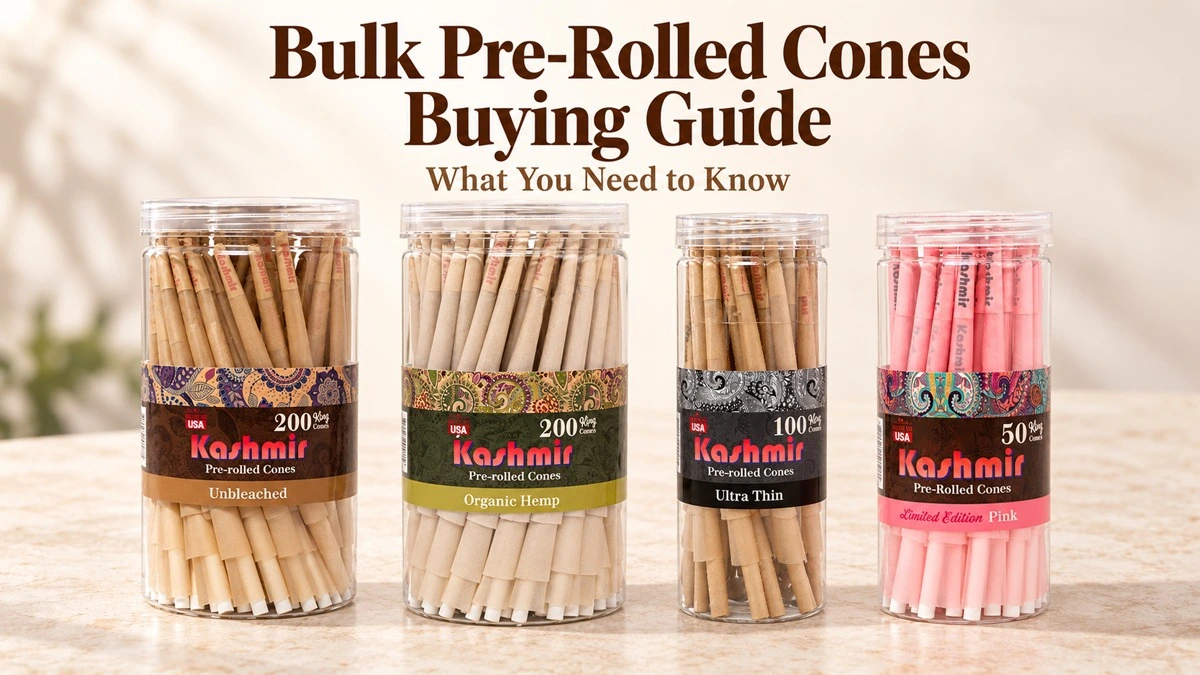
Bulk Pre-Rolled Cones Buying Guide: What You Need to Know
Bulk pre-rolled cones are mainly designed for situations where a steady supply is needed. That can include pre-roll production, dispensaries, retailers, and other businesses that regularly work with larger quantities of empty cones.
Buying in bulk can also make sense for individual buyers who already know the exact size and paper type they prefer, but the biggest advantage is usually consistency. Instead of repeatedly ordering smaller jars, a bulk box keeps more cones available at once and can simplify purchasing for higher-volume use.
There is still more to compare than the number printed on the box. Cone size, paper material, packaging, storage, and cost per cone all matter, especially when you are buying hundreds or thousands at a time.
When Does Buying Pre-Rolled Cones in Bulk Make Sense?
Bulk boxes are most useful when cones are being used regularly and in larger quantities.
For pre-roll producers, dispensaries, retailers, or other businesses, ordering larger quantities can make day-to-day inventory easier to manage. A steady supply of the same cone size and paper type can help reduce frequent reordering and make it easier to maintain consistency across production.
In those settings, compatibility matters just as much as quantity. Cone dimensions need to work with the filling process or equipment being used, and packaging should protect the cones while they are stored and handled.
Individual buyers may also choose larger packs when they already know the product they use regularly. Someone who occasionally uses cones may be fine with a 50- or 100-count container, while someone who goes through the same size consistently may find a larger quantity more practical.
Trying a new paper type is a different situation. If you have never used bamboo, hemp, or a particular unbleached cone before, starting with a smaller pack gives you a chance to check the paper and size before moving into a bulk box.
Common Bulk Pack Sizes: How Much Is Enough?
Pre-rolled cones are sold in several quantities, and the jump from a smaller jar to a full bulk box is significant.
Smaller packs such as 50, 100, or 200 cones are useful when testing a new product or managing lower-volume use. They take up less storage space and make it easier to switch materials or sizes without being committed to a large quantity.
For commercial or higher-volume use, 1000 pre rolled cones are a common bulk format, particularly in King Size. Some manufacturers also offer 1,100-count boxes in shorter 1¼ sizes.
The count on the box should not be viewed on its own. A 1,000-count King Size box and a 1,100-count 1¼ box serve different needs because the cones differ in length and capacity.
For a business, the right quantity often comes down to production volume and reorder frequency. A box that covers regular demand without sitting unused for an extended period is usually more practical than simply choosing the largest count available.
Bamboo, Hemp, or Unbleached: Which Paper Should You Buy?
Paper material is worth deciding on before comparing bulk pricing.
Bamboo cones are made from bamboo-derived fibers. They can be produced as relatively thin papers, and some buyers prefer their lighter feel. If you are looking at bamboo cones bulk options, compare the specific paper construction and cone size rather than assuming every bamboo product will feel the same.
Hemp cones use hemp-based paper. Depending on how the paper is manufactured, the texture and appearance may differ from bamboo or other papers. Hemp is widely used in pre-rolled formats, including larger bulk quantities.
Unbleached cones are slightly different because “unbleached” describes how the paper was processed rather than identifying one particular plant fiber. These papers often retain a brown or tan appearance because they have not gone through a whitening stage. An unbleached cone may still be made from hemp, bamboo, or another suitable fiber.
That distinction is important when comparing bulk unbleached cones with bamboo or hemp products. These categories can overlap.
For businesses, it is usually helpful to settle on the paper material and size before placing a large order. Once a particular format works well with the intended production process, larger quantities become easier to plan around.
How to Compare Bulk Cone Pricing
A lower box price does not automatically mean a better value.
The easiest way to compare bulk packs is to calculate the cost per cone. Divide the total price by the number of cones in the package.
For example, if a 200-count jar costs $20, the cost works out to 10 cents per cone. If a 1,000-count box costs $75, the cost per cone drops to 7.5 cents. These are only illustrative figures, but they show why comparing unit cost is more useful than looking at the total box price alone.
It is also important to compare like with like. A 200-count jar of bamboo King Size cones should not automatically be compared with a larger box of shorter unbleached cones. Differences in paper material, size, and packaging can all affect the price.
For dispensaries and pre-roll producers, shipping costs and wholesale terms may also matter. A lower unit price can lose some of its advantage if delivery costs are significantly higher, while larger commercial orders may qualify for separate wholesale pricing.
Packaging quality also affects value. If cones are crushed or bent before use, the lowest-priced box may not be the most economical option in practice.
Why Packaging Matters When Buying in Bulk
Bulk cones are lightweight and hollow, so protecting their shape matters during storage and handling.
The wider opening can bend, the paper can crease, and pressure on the package can affect the cone before it ever reaches the filling stage. This becomes more important when hundreds or thousands of cones are being stored together.
Some bulk products use tower-style packaging or other organized arrangements that keep the cones nested and protected. Smaller quantities are often sold in jars. Each format has a different storage footprint and handling process.
For pre-roll production, packaging can also affect workflow. A box that keeps cones organized and easy to access may be more useful than one that requires frequent handling or rearranging.
This is why packaging is worth considering alongside paper material and price. A bulk order needs to remain practical from delivery through storage and use.
How to Store Bulk Pre-Rolled Cones
Storage becomes more important when cones are being purchased in large quantities.
Keeping the cones in their original protective packaging is usually the simplest approach. Store them in a cool, dry area away from direct sunlight, excessive heat, and noticeable humidity changes. Paper can absorb moisture from the surrounding environment, which may affect how it handles.
Avoid placing heavy items on top of bulk boxes, especially if the packaging is not designed to support additional weight. Even slight pressure can bend or flatten the wider ends of the cones.
For businesses holding multiple boxes, organizing stock so older inventory is used before newer shipments can make management easier. This is particularly useful for dispensaries, retailers, and pre-roll production environments where larger quantities may be stored at the same time.
If a smaller working quantity is needed during production, it can be practical to remove only what is required and leave the rest of the bulk supply protected in its original packaging.
Choosing Bulk Pre-Rolled Cones From Kashmir
Kashmir offers pre-rolled cones in several paper materials and pack quantities, including bamboo, organic hemp, unbleached, and ultra-thin options.
For larger-volume buyers, selected products are available in 1,000-count King Size boxes and 1,100-count 1¼ boxes. Smaller 100- and 200-count options are also available, which can be useful for testing a particular paper or size before moving into a larger purchase.
For pre-roll producers, dispensaries, or retailers, the best place to start is with the intended cone size and paper material. Once those are established, compare the available pack quantity, packaging, and cost per cone.
Kashmir’s larger bulk formats are intended for buyers who need a more consistent supply, while the smaller packs provide a practical way to evaluate a product before committing to higher-volume purchasing.