
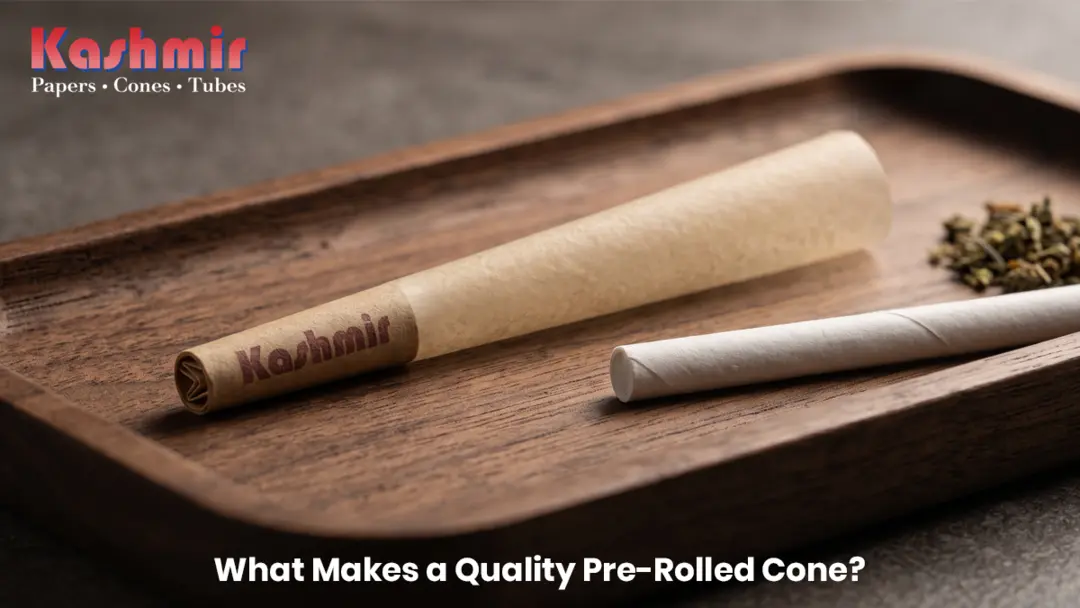
What Makes a Quality Pre-Rolled Cone?
A pre-rolled cone can look simple from the outside, but a lot of small details determine whether it is actually well made.
The paper needs to be consistent. The cone should hold its shape while being filled. The tip should stay secure. The gum line needs to seal properly. And once packed, the cone should allow steady airflow without obvious weak spots in the paper.
That is a more useful way to think about the best pre-rolled cones.
Not as one universally “best” product, but as cones that are built well and match the way you prefer to use them.
Start With the Paper, It’s the Foundation of the Cone
The paper is the most important part of a pre-rolled cone.
Everything else, the seam, the tip, the shape and even how the cone handles during filling, depends on the paper being well made in the first place. If the sheet is inconsistent, overly heavy, poorly formed or too fragile, the rest of the cone cannot fully make up for it.
A quality cone should use paper with an even thickness from end to end. The surface should look consistent, without obvious weak spots, wrinkles or areas where the paper appears noticeably heavier or thinner.
Thinness matters too, but thinner does not automatically mean better.
A good paper should feel light enough that it does not add unnecessary bulk, while still being strong enough to handle normal filling and packing without tearing easily. This balance between paper weight, strength and flexibility is one of the clearest signs of good construction.
The fiber or paper style also changes how the cone feels. Hemp, bamboo, unbleached and ultra-thin papers each have their own texture and handling characteristics, but the material name alone does not guarantee quality.
What matters most is how well that material has been turned into the finished sheet.
When comparing pre-rolled cones, start with the paper before looking at anything else. A secure tip and clean seam are important, but they are only as good as the paper holding everything together.
The Cone Should Hold Its Shape
A good pre-rolled cone should arrive looking like a cone.
That sounds obvious, but shape retention matters.
If the paper is crushed, bent or poorly formed, packing becomes more difficult and the finished result can feel uneven.
A quality cone should stay open while you fill it and should not collapse under light pressure.
This is one reason packaging matters too. Small packs, jars and bulk boxes all need to protect the cone shape during storage.
Kashmir currently sells cones in several pack styles and quantities, from small 3- or 6-count packs to 50, 100 and 200-count containers and larger bulk boxes.
That range is useful, but whatever the quantity, the cone itself still needs to arrive intact.
Tip Design Matters More Than It Looks
The built-in tip is one of the most functional parts of a pre-rolled cone.
It helps the cone keep its shape at the narrow end, gives you something firm to hold and can help prevent loose material from reaching your mouth.
Kashmir uses a W-shaped tip design across several cone ranges, including unbleached and bamboo options.
A poorly fitted tip can move, loosen or distort the base of the cone.
A well-fitted tip should feel secure and line up cleanly with the paper.
This is the kind of feature that is easy to ignore on the package but becomes obvious once you start using the cone.
Look at the Seam and Gum Line
The seam is another small detail that tells you a lot about construction quality.
The paper should be joined cleanly along the cone without obvious lifting, wrinkles or loose sections.
The gum line should hold the paper together without making the cone feel stiff or uneven along one side.
If the seam starts opening while you are filling the cone, that is a construction problem.
A well-made cone should stay closed through normal handling and packing.
You do not need an elaborate technical specification here. A simple visual check usually tells you whether the paper has been formed neatly.
Burn Consistency Is About More Than Thin Paper
A lot of cone marketing focuses on slow or even burning.
That matters, but it should not be judged by paper thickness alone.
Paper construction, embossing, packing density and airflow all affect how a filled cone burns.
Kashmir’s unbleached cones, for example, are described as using embossed paper designed for a slow and even burn. Its bamboo and organic hemp ranges are also positioned around steady or even-burning paper.
That gives us a useful standard to look for: the paper should be designed to burn consistently, but the cone also needs to be packed properly.
Even a well-made cone can burn unevenly if one side is packed tightly and the other is loose.
So when judging quality, think of burn performance as a combination of paper construction + cone shape + packing.
Airflow Should Feel Consistent
A good cone should not feel blocked once it is packed.
The built-in tip, paper shape and packing density all contribute to airflow.
Kashmir describes several of its cone designs as using structured tips intended to support airflow while keeping the cone stable.
This is where overly tight packing can undo good cone construction.
If the cone is compressed too heavily near the tip, airflow can become restricted even if the paper and tip are well made.
So the cone should give you a solid starting structure, but the final result still depends on how it is filled.
Material Options: Hemp, Unbleached, Bamboo and Ultra-Thin
Material changes the feel of the cone, but it does not automatically create a quality ranking.
Organic Hemp Cones
Kashmir’s organic hemp cones are made from organic hemp fiber and are available in 1¼ and King Size formats. The brand describes them as chlorine-free and designed for steady burning and consistent shape retention.
Hemp can be a good option for someone who prefers a plant-fiber paper with a little more body.
Unbleached Cones
Unbleached cones keep their natural brown appearance because they have not been whitened in the same way as conventional white paper.
Kashmir’s unbleached range is chlorine-free and available across several pack sizes, from small packs to bulk boxes.
Bamboo Cones
Kashmir’s bamboo cones are made from bamboo fiber and are described as thin, flexible and strong, with built-in W-shaped tips.
That combination can appeal to someone who wants a lighter paper without making the cone feel overly delicate.
Ultra-Thin Cones
Ultra-thin cones use less paper material around the fill.
Kashmir’s current ultra-thin cone range includes 1¼ and King Size options in small packs, jars and bulk boxes.
The lighter paper feel is the main attraction here, but thinness still needs to be balanced with strength.
A paper that is thin but tears too easily would not be a quality cone.
Choose the Right Size
Cone size affects how much you can fill and how easy the cone is to handle.
Kashmir currently offers common formats including 1¼ and King Size across several cone categories.
A smaller cone makes sense when you do not need much capacity.
A larger cone gives you more room, but it also takes more material to fill evenly.
The “right” size is therefore not a quality issue by itself.
A well-made 1¼ cone and a well-made King Size cone can both be quality products. The better choice depends on how much space you actually need.
Small Packs vs Bulk Packs
Pack quantity does not change the paper itself, but it changes how practical the product is for you.
Small packs are useful if you want to try a material or size before buying more.
Larger jars or boxes make more sense if you already know what you use regularly.
Kashmir currently sells cones in small 3- and 6-count packs, medium 50-, 100- and 200-count options, and bulk formats reaching 1,000 or 1,100 cones depending on the product line.
The bigger consideration is storage.
Cones can be crushed more easily than flat rolling papers, so the container should protect their shape and keep them organized.
A Quick Quality Checklist
Before choosing a pack, look for these practical signs:
| Feature | What to Look For |
| Paper | Thin but not fragile |
| Shape | Cone stays open and holds its form |
| Seam | Clean, secure and evenly joined |
| Tip | Firm, aligned and securely fitted |
| Gum | Holds without lifting |
| Paper surface | Even, without obvious weak spots |
| Burn design | Paper marketed and constructed for consistent burning |
| Size | Fits the amount you actually plan to fill |
| Packaging | Protects cones from crushing |
| Product details | Clear information about material, size and construction |
That checklist is more useful than relying on phrases such as “premium” or “best cones for smoking” without knowing what those claims are based on.
So, What Makes a Quality Pre-Rolled Cone?
A quality cone is one that is well constructed from the beginning.
The paper should feel consistent. The shape should hold. The tip should stay in place. The seam should remain closed. And the cone should give you a reliable structure to fill and pack.
Material comes after that.
You might prefer organic hemp cones, unbleached paper, bamboo or ultra thin cones, but none of those labels replaces good construction.
If you are comparing pre rolled cones, start with the basics:
paper quality, cone shape, tip, seam, airflow and size.
Then choose the material and pack quantity that suit your preferences.
That gives the phrase best pre rolled cones a much more practical meaning: not a universal winner, but a cone that is made well and fits the way you use it.
Kashmir’s current range includes organic hemp, unbleached, bamboo, ultra-thin, flavored and other pre-rolled cone styles across multiple sizes and quantities, giving shoppers several ways to compare those characteristics.