
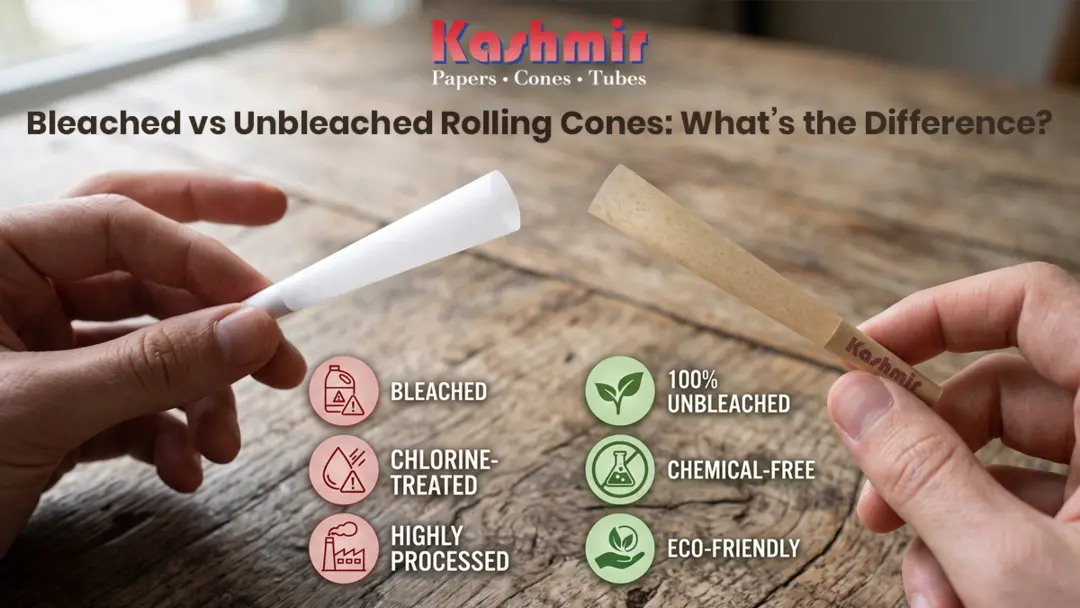
Bleached vs Unbleached Rolling Cones: What’s the Difference?
The easiest way to tell a bleached cone from an unbleached one is usually the color.
Bleached papers are processed to create a lighter or whiter appearance. Unbleached papers keep more of the natural color of the pulp, which is why they are typically tan or light brown.
That visible difference is real, but it is also where a lot of oversimplification starts.
A white cone is not automatically poor quality, and a brown cone is not automatically better in every way. The bleaching process is only one part of how a paper cone is made. Fiber type, paper weight, gum, embossing and overall construction still matter.
So when comparing bleached vs unbleached cones, it helps to separate what we know from what is mostly packaging language.
What Does “Bleached” Mean in Paper?
Bleaching is a papermaking process used to increase the brightness of pulp.
In conventional paper manufacturing, bleaching can remove or alter compounds that give untreated pulp its darker color. Different bleaching systems exist, and they do not all use the same chemistry. The paper industry has used processes involving chlorine compounds, chlorine-free systems, oxygen, peroxide and other treatments depending on the type of pulp and the required result. The U.S. EPA describes bleaching primarily as a way of brightening pulp and notes that several different bleaching sequences are used in modern paper production.
That is an important distinction.
It would be too broad to say that every white rolling cone is simply “chlorine bleached.” White paper can be produced using different processing methods. There is also an oxygenation process that some manufacturers use rather than the kind of chlorine treatment people often associate with the word “bleached.”
For shoppers, the practical point is simple: if the bleaching method matters to you, check the individual manufacturer’s specifications rather than assuming the process from color alone.
For shoppers, the practical point is simple: if the bleaching method matters to you, look at the individual manufacturer’s specifications rather than assuming the process from color alone.
What Are Unbleached Rolling Cones?
Unbleached rolling cones are made from paper that has not gone through a whitening process intended to give the sheet a bright white appearance.
As a result, the paper usually keeps a beige, tan or light-brown color.
Kashmir describes its unbleached cones as using naturally brown, chlorine-free paper. Its current 1¼ and King Size products are specifically positioned around that unbleached construction.
That natural-looking color is probably the most immediate difference you will notice when placing a bleached and unbleached cone side by side.
But color alone does not tell you the thickness of the sheet, the type of gum used or how the cone will handle.
Those are separate specifications.
Appearance: White vs Natural Brown
This is the most straightforward part of the comparison.
A conventional bleached paper generally has a brighter, whiter appearance.
An unbleached paper tends to retain a light-brown or tan tone because it has not been whitened in the same way as conventional white paper. In general, unbleached papers go through less whitening-related processing, which is why more of the paper’s natural color remains visible.
For some people, that appearance is part of the appeal of natural pre rolled cones.
Others may simply prefer the clean visual look of a white cone.
From a practical standpoint, though, color is mostly telling you something about the paper’s processing. It does not by itself establish how thin, strong or slow-burning the finished cone will be.
Does Unbleached Mean “Chemical-Free”?
This is where wording needs to be careful.
“Unbleached” tells you that the paper has not been put through a whitening or bleaching stage in the same way as bleached pulp. It does not automatically tell you every detail about the manufacturing process.
Likewise, “bleached” does not mean every product uses the same chemicals.
Modern papermaking includes several bleaching methods, including processes described as elemental chlorine-free or totally chlorine-free.
So rather than treating “bleached” and “unbleached” as shorthand for “bad” and “good,” check the actual product information.
Kashmir’s unbleached cones make this easier because the brand specifically states that these products use chlorine-free, unbleached paper.
That is a verifiable product characteristic.
Burn and Paper Characteristics
It is tempting to assume that bleaching alone determines burn speed, but that is too simplistic.
The way a cone burns is influenced by several things at once: paper thickness, fiber composition, density, embossing, packing and airflow.
Kashmir describes its unbleached cones as using embossed paper designed for a slow, even burn.
That tells us something useful about Kashmir’s particular unbleached cones.
It does not prove that every unbleached cone burns slower than every bleached cone.
The same principle applies to thickness.
A brown paper can be thin or relatively substantial. A white paper can also be made in different weights. Bleaching describes a processing choice, not a universal thickness specification.
So if burn behavior matters to you, look for direct information about the actual cone rather than relying on color.
Does the Paper Taste Different?
This is another area where blanket claims are common.
Some manufacturers position unbleached papers as having a more neutral or less noticeable paper taste. Kashmir, for example, describes its unbleached cones as intended to let the flavor of the contents remain more prominent.
But taste is subjective, and it can also be affected by paper thickness, fiber type and what is packed inside the cone.
So I would not reduce the choice to:
brown paper = no taste
white paper = paper taste
That would be far too definite.
The more defensible point is that processing and paper construction can influence how noticeable the paper feels or tastes, and unbleached papers are often chosen by people who prefer a less processed paper format.
Bleached vs Unbleached Cones at a Glance
| Characteristic | Bleached Cones | Unbleached Cones |
| Appearance | Usually white or lighter | Usually tan or light brown |
| Processing | Paper has undergone a brightening or whitening process | Paper has not been whitened in the same way |
| Bleaching method | Can vary by manufacturer | No bleaching stage for whitening |
| Thickness | Varies by product | Varies by product |
| Burn rate | Depends on paper construction | Depends on paper construction |
| Paper taste | Product-specific and subjective | Often chosen by people seeking a less processed paper |
| What to verify | Bleaching method, fiber, thickness, gum | Fiber, thickness, gum and processing claims |
The biggest factual difference is the processing and resulting appearance.
Many of the other characteristics people associate with bleached or unbleached papers actually come from the finished paper design rather than the color alone.
What Should You Check Beyond Bleaching?
If you are already comparing two cone packs, look past the words “bleached” and “unbleached.”
The fiber is worth checking first. A cone might be made from wood-based paper, hemp, bamboo or another material.
Then look at the thickness.
A very thin cone will feel different from a heavier paper regardless of whether it is white or brown.
The gum and cone construction matter as well. Pre-rolled cones need to hold their shape, seal properly and stay consistent while being filled.
And finally, read the manufacturer’s exact processing claims.
If a brand says the cone is chlorine-free, unbleached or made without a specific whitening treatment, that is much more useful than guessing from appearance.
Which Type Should You Choose?
Choose unbleached cones if you prefer paper with a natural brown appearance and want to avoid a whitening stage in the paper-making process.
Choose bleached or white cones if you prefer the lighter appearance and the manufacturer provides a paper construction and processing method that suits your preferences.
There is no need to turn the comparison into a universal quality ranking.
A well-made white cone can still be thin, consistent and functional.
A well-made unbleached cone can offer those same practical qualities while using a less whitened paper style.
For most people, the meaningful question is not simply:
“Is the cone white or brown?”
It is:
“How was this particular paper made, and what does the manufacturer actually tell me about it?”
Kashmir Unbleached Cone Options
Kashmir’s current pre-rolled cone range includes several unbleached formats.
The brand lists 1¼ unbleached cones in multiple pack counts, including 6, 100 and 200-count options. Its 1¼ unbleached paper is light brown and listed at approximately 78 mm.
There are also King Size unbleached cones, with current product pages listing a 109 mm format.
Across these products, Kashmir consistently describes the paper as unbleached and chlorine-free and uses a built-in tip and embossed paper construction.
That gives shoppers something more useful than the brown color alone: actual information about the paper and construction.
If you are specifically looking for unbleached cones, that is the kind of product detail worth comparing.