
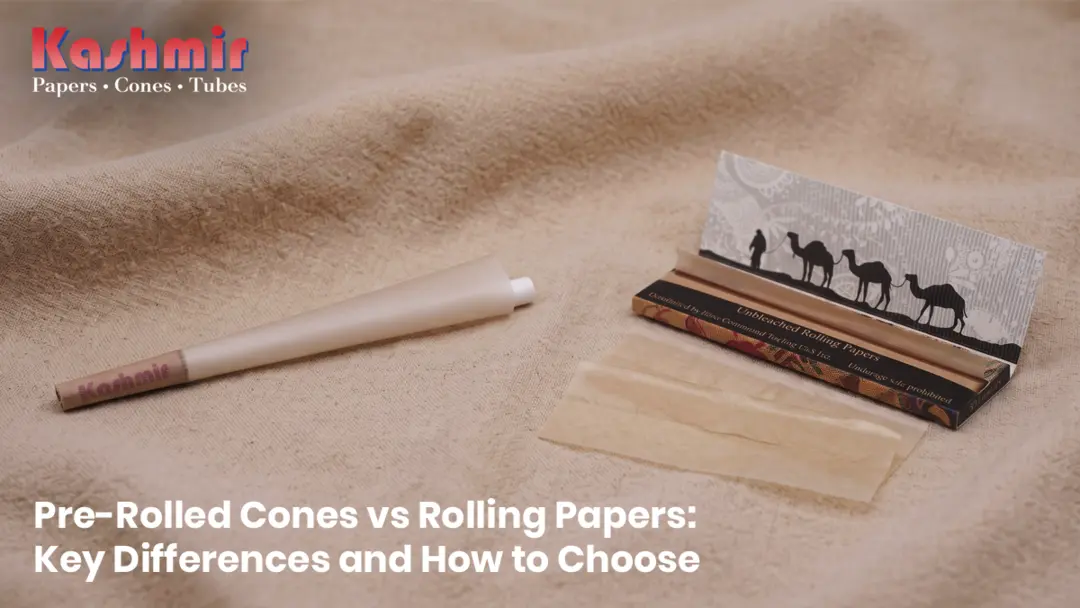
Pre-Rolled Cones vs Rolling Papers: Key Differences and How to Choose
Pre-rolled cones and rolling papers start with the same basic idea: a paper wrapper that holds the material being rolled. The difference is how much of the work has already been done before you pick it up.
A rolling paper is a flat sheet. You decide the shape, add a tip if you want one, distribute the material, roll the paper around it and seal the edge.
A pre-rolled cone arrives already formed into a tapered shape, usually with a tip fixed at the narrow end. You skip the shaping step and concentrate on filling and packing instead. Structurally, that is the main difference between the two formats.
That change affects more than convenience. It changes how much control you have over the finished shape, where packing errors tend to happen, how the product is stored, and how consistent one finished roll can be compared with the next.
A Cone Starts With a Fixed Shape. Rolling Paper Does Not.
This is the most useful place to begin.
With a cone, the taper, length and width have already been established. The narrow end and tip are already in place, and the wide end is left open for filling.
With a rolling paper, none of that shape exists yet.
The flat sheet becomes whatever the person rolling it can make. It may end up straight, slightly tapered, wide, narrow, tightly formed or fairly loose.
That freedom is one of the biggest advantages of loose papers for an experienced roller. You are not locked into a predetermined cone shape.
It is also where the learning curve comes from.
A cone removes most of the shaping skill. A rolling paper gives you more control, but you have to create the structure yourself.
Packing Works Differently in the Two Formats
Cones are sometimes described as easier simply because they do not need to be rolled. That is true, but it can hide an important point:
A cone still has to be packed properly.
Because the shape is fixed, your main job is distributing the material evenly from the narrow end upward. If the bottom is packed much more tightly than the top, or if loose pockets remain inside, airflow can become uneven.
With a rolling paper, distribution happens before and during the roll. You can move the material across the sheet, adjust the density with your fingers and shape the roll as you close it.
That gives loose papers more room for correction during preparation.
Research and industry guidance on cones consistently point to even packing as one of the main factors affecting airflow and burn behavior. Tight sections can restrict airflow, while loose areas can create inconsistent burning.
So cones simplify one skill—shaping—but they make packing consistency more important.
Control Is the Biggest Advantage of Rolling Papers
Loose papers require more practice, but they give the roller more control over the finished result.
You can decide how much material to spread across the paper, how wide to make the roll, how tightly to form it, whether to use a tip and how large that tip should be.
You can also adjust as you go.
If one side looks too full, you can redistribute the material before sealing the paper. If the roll feels too loose, you can tighten the shape while forming it.
With a cone, most of those decisions have already been made for you.
The cone has a fixed taper. The tip is usually already installed. Capacity is largely determined by the dimensions of the cone, although how much you actually put inside still depends on packing density. Structural references make this distinction clearly: flat rolling papers are primarily defined by sheet dimensions, while cones also have formed geometry, taper and tip dimensions.
That is why the real comparison is not simply “easy versus difficult.”
It is convenience versus control.
The Tip Is Built In With Most Cones
Another practical difference is the tip.
Most pre-rolled cones come with a paper tip already fitted at the narrow end. That gives the cone structure and removes another preparation step.
With loose rolling papers, the tip is optional and separate.
Some people roll without one. Others use pre-rolled tips, fold their own, or choose a particular tip width to affect the final shape.
This is another example of the same trade-off.
The cone gives you consistency because the tip is already there.
Rolling papers give you choice because you decide whether to use one and how it should be made.
Shape Affects How You Fill
A pre-rolled cone is wider at the open end and gradually narrows toward the tip.
That geometry changes how you fill it.
You normally start with smaller amounts near the narrow section, allow them to settle, and add more as the cone widens. Filling too quickly can leave open spaces farther down the cone.
A hand roll is different because you are distributing the material across a flat sheet before the final shape exists.
You can see the distribution as you work.
That makes it easier to correct uneven areas before the paper is closed.
This is one reason some experienced rollers continue to prefer papers even though cones are easier to prepare. They like seeing and controlling the density from beginning to end.
Which Format Gives More Consistent Results?
This depends on what you mean by consistency.
Cones are more consistent in shape because that shape is created during manufacturing rather than by hand. One cone of the same size should begin with a very similar geometry to the next.
Rolling papers are more dependent on the person using them.
Someone with strong rolling technique may produce highly consistent rolls. Someone still learning may end up with noticeably different results each time.
So a cone reduces variation in structure.
It does not eliminate variation in packing.
That distinction is important.
A badly packed cone can still perform poorly. A well-made hand roll can perform very consistently. Industry comparisons similarly note that cones reduce the shaping variable while hand rolling gives more direct control over density and airflow.
Size Means Something Different With Cones
Both formats come in several sizes, but you are choosing different things.
When you buy a cone, you are choosing an already formed structure.
The size tells you roughly how long the cone is and how much space is available inside that shape.
When you buy a rolling paper, you are choosing a flat sheet.
That sheet gives you a working area rather than a finished capacity.
Two people can use the same paper size and still produce rolls that are noticeably different in diameter or density.
With cones, there is less freedom because the body has already been formed.
That makes cone sizing more predictable, while loose paper sizing leaves more of the final result to the roller.
Kashmir currently carries common cone formats including 1¼ and King Size, while its rolling-paper range includes several loose-sheet formats. That reflects the same broader distinction between choosing a finished shape and choosing a sheet to shape yourself.
Material Does Not Belong to Only One Format
It is easy to think of cones and papers as though they represent different paper materials.
They do not.
The format and the paper material are two separate choices.
Cones can be made from hemp, bamboo, unbleached paper and ultra-thin paper constructions. Rolling papers can be made from many of the same fibers and styles, along with options such as rice-based papers.
So if someone prefers hemp, for example, they do not necessarily have to choose between hemp and cones.
They may be able to choose between a hemp cone and a hemp rolling paper.
The first decision is the format.
The second is the type of paper.
Keeping those separate makes the comparison much clearer.
Do Cones Burn Differently From Rolling Papers?
There is no useful rule that says cones always burn one way and rolling papers always burn another.
The paper is only part of the equation.
Packing density, airflow, paper thickness, material distribution and how evenly the roll is formed all affect burn behavior.
The difference is where those variables are controlled.
With a cone, the outer shape has already been standardized, so much of the remaining variation comes from how evenly the cone is filled.
With rolling papers, both the outer shape and the material distribution are created by the person rolling.
That gives the user more control, but also more opportunity for inconsistency.
So it is better to think of burn performance as a result of paper + construction + packing, rather than treating cone versus paper as a burn-speed comparison.
Storage and Portability Are Easy to Overlook
Flat rolling papers are easy to carry.
A booklet takes up very little space, and the papers remain flat until they are used.
Pre-rolled cones are different because the shape already exists. That means the packaging has to protect the cone from being crushed or bent.
This can matter more than people expect.
A cone may save time during preparation, but it normally takes up more room in storage than a booklet of loose papers.
For someone carrying a small amount of gear, papers are usually the more compact option.
For someone who values faster preparation once everything is set up, the extra space taken by cones may not matter.
Again, the difference is practical rather than a question of which one is universally better.
Pre-Rolled Cones vs Rolling Papers at a Glance
| Feature | Pre-Rolled Cones | Rolling Papers |
| Starting form | Already shaped and sealed | Flat sheet |
| Tip | Usually built in | Optional and separate |
| Main skill | Filling and even packing | Distributing, shaping and rolling |
| Shape control | Mostly fixed | Controlled by the roller |
| Packing correction | More limited once filled | Easier before sealing |
| Structural consistency | High from cone to cone | Depends on rolling technique |
| Portability | Needs protection from crushing | Flat and compact |
| Material choice | Available in several paper types | Available in several paper types |
| Best fit | Convenience and repeatable shape | More control and customization |
The table makes the core distinction easier to see:
Cones standardize the structure. Papers leave the structure in your hands.
Which Format Makes More Sense for You?
A pre-rolled cone makes sense if you would rather spend your time filling and packing than shaping paper.
It is especially practical if hand rolling is not something you enjoy or if you want the starting shape to be consistent from one cone to the next.
Rolling papers make more sense if the rolling process itself matters to you.
They give you more freedom to control the diameter, density, shape and tip. That extra control is useful, but it requires more technique.
There is also no reason you have to use only one format.
Some people may prefer papers when they have time to roll carefully and cones when convenience matters more.
That is probably a more realistic way to look at the comparison than trying to name a winner.
Where Kashmir Fits
Kashmir offers both formats, which makes the comparison easy to apply in practice.
Its current pre-rolled cone range includes 1¼ and King Size formats across paper styles such as organic hemp, unbleached, bamboo, ultra-thin, flavored and colored options. The rolling-paper range includes multiple sheet sizes and paper materials as well.
The useful thing about that range is not that one format replaces the other.
It is that the choice can be made in two stages:
first choose cone or loose paper, then choose the paper style and size you prefer.
That keeps the buying decision much simpler.
Final Thoughts
Pre-rolled cones and rolling papers are not just two versions of the same product.
They divide the preparation process differently.
With a cone, the manufacturer creates the shape and installs the tip. You control the fill.
With a rolling paper, you control almost everything from the beginning.
That makes cones easier to standardize and quicker to prepare, while rolling papers give experienced rollers more freedom to adjust shape and density.
So if you are deciding between rolling cones and loose papers, the most useful question is not “Which is better?”
It is:
How much of the rolling process do you want to control yourself?
That question gets much closer to the real difference between the two.